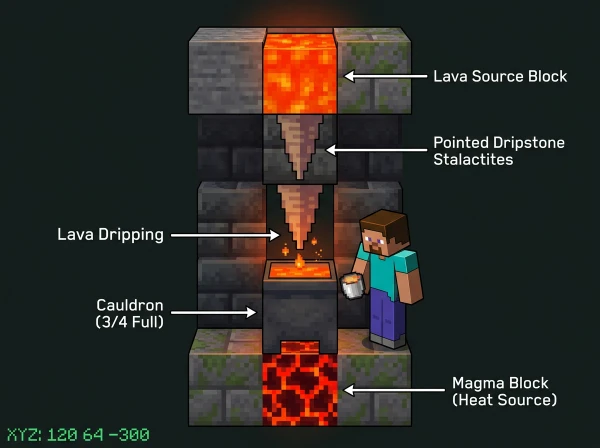
Creating lava generators saves time collecting lava manually.
Automated lava farms provide infinite lava for your projects.
Quick Answer: How to Build a Lava Generator
Build a lava generator using a cauldron, dripstone, and pointed dripstone blocks. Place a heat block (magma/campfire) below to create lava droplets. The dripstone drips lava into a cauldron below. Collect full cauldrons with buckets for infinite lava supply.
Understanding Lava Generators
Lava generators are automated contraptions that produce lava.
They use Minecraft’s dripstone mechanic to generate lava passively.
No manual mining or exploration required once built.
Key lava generator facts:
- Works with pointed dripstone blocks
- Requires cauldrons to collect lava
- Heat source activates lava dripping
- Works in any dimension
- Generates lava infinitely
- Works in survival and creative modes
- Takes 15-30 seconds per bucket
Lava generators are essential for large-scale building projects.
How Dripstone Lava Generators Work
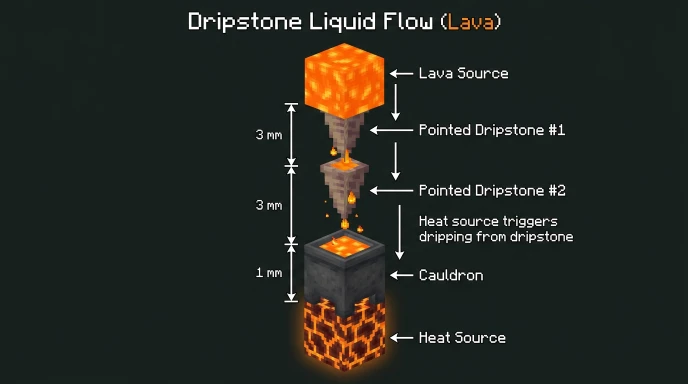
Dripstone lava mechanics depend on specific block placements.
Lava source blocks drip onto pointed dripstone.
The dripstone redirects liquid downward into cauldrons.
Heat sources like magma blocks or campfires trigger dripping.
The process:
- Place lava source block above pointed dripstone
- Place second pointed dripstone below the first
- Place cauldron under the bottom dripstone
- Add heat source below cauldron
- Lava drips and collects in cauldron
Step-by-Step Lava Generator Construction
Materials You Need
Gather these items before starting construction:
- Lava source block (1 minimum)
- Pointed dripstone (2-3 blocks)
- Cauldrons (1 or more)
- Magma block or campfire
- Building blocks for structure
- Water bucket (for safety)
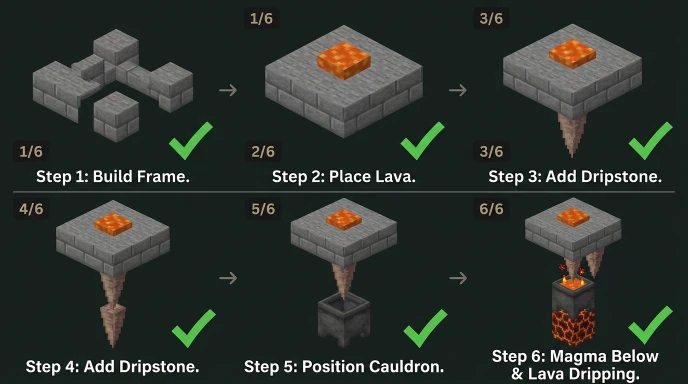
Step 1: Create the Frame
Build a platform for your generator.
Use any solid blocks you prefer.
Make it accessible for collecting lava buckets.
Add safety walls around the heat source area.
Step 2: Place the Lava Source
Position lava source block at the top.
Make sure it’s directly above your dripstone chain.
The lava must flow onto the pointed dripstone.
Step 3: Install the Dripstone
Place first pointed dripstone under lava source.
Place second pointed dripstone 1-2 blocks below.
Ensure alignment for proper liquid flow.
Test the dripping by looking at the block.
Step 4: Add the Cauldron
Position cauldron under the bottom dripstone.
The dripping lava must fall into it.
Leave 1 block gap between dripstone and cauldron.
Step 5: Place Heat Source
Add magma block or campfire below cauldron.
Heat activates the dripstone dripping mechanism.
Magma blocks work better than campfire for auto-dripping.
Step 6: Test and Collect
Wait 15-30 seconds for lava to accumulate.
Use bucket on cauldron to collect full lava.
Repeat process for continuous supply.
Lava Generator Types Comparison
| Generator Type | Speed | Efficiency | Complexity | Drops |
|---|---|---|---|---|
| Basic Cauldron | Slow | Low | Easy | 1 bucket per 30 seconds |
| Magma Heated | Medium | Medium | Medium | Multiple per minute |
| Dual Cauldron | Fast | High | Hard | 2 buckets per minute |
| Redstone Automated | Very Fast | Very High | Very Hard | Continuous buckets |
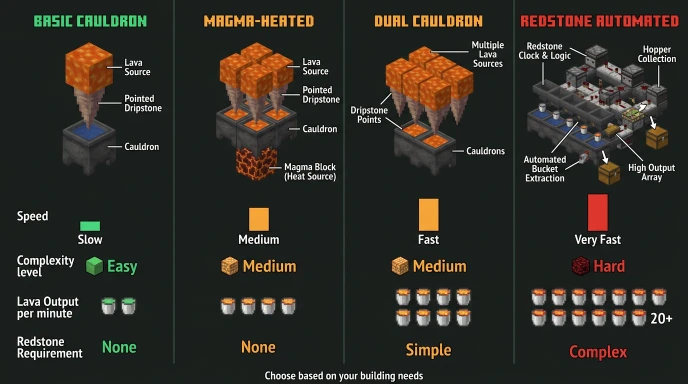
Basic cauldron generators work fine for most players.
Practical Tips for Lava Generators
Best Heat Source Choices
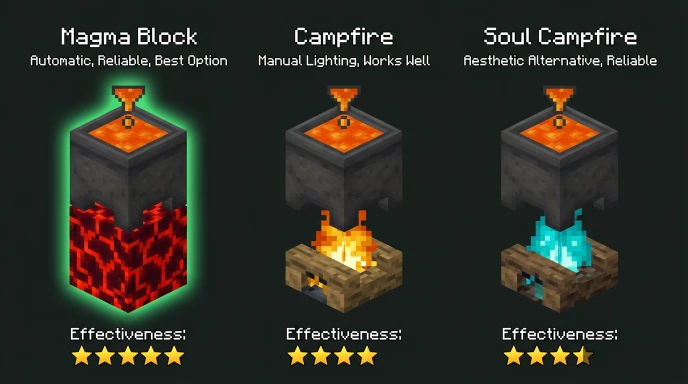
Magma blocks provide automatic heating.
Campfires require manual lighting but work.
Soul campfires look better aesthetically.
Magma blocks are most reliable for constant dripping.
Increasing Generation Speed
Stack multiple generators side by side.
Use multiple cauldrons per dripstone column.
Place heat sources immediately below cauldrons.
Common Generator Mistakes
Placing dripstone horizontally instead of vertically.
Forgetting heat source below cauldron.
Using water instead of lava sources.
Not leaving proper spacing for cauldron access.
Placing cauldrons too high or low.
Safety Considerations
Keep generators away from flammable blocks.
Use water moats around lava areas.
Don’t place generators in wooden structures.
Keep distance from important builds.
Test generators before leaving unattended.
Using Generated Lava Efficiently
Storage Methods
Use cauldrons as temporary storage.
Transfer to buckets for transport.
Create barrel storage systems for bulk lava.
Lava Applications
Flowing lava for landscaping.
Lava lighting for bases.
Lava moats for protection.
Lava farms for other materials.
Smelting furnace fuel source.
Finding Optimal Generator Locations
OreFinder’s structure finder helps locate nearby lava pools and caves.
Use your world seed to find natural lava sources nearby.
This helps you establish generator farms closer to resources.
Check our guides on finding strongholds and trail ruins for lava-rich areas.
Advanced Generator Automation
Redstone-Powered Generators
Connect hoppers with redstone mechanics.
Automate bucket collection with dispensers.
Use observer blocks to trigger mechanisms.
This requires advanced redstone knowledge.
Multi-Output Systems
Build stacked generator towers.
Connect multiple cauldrons vertically.
Route lava to central collection point.
Scale production for mega-builds.
FAQ
How do you make a lava generator in Minecraft?
Build a frame with lava source block on top. Place pointed dripstone below it, then another pointed dripstone below that. Put a cauldron under the bottom dripstone. Add magma block or campfire below cauldron for heat. Wait 15-30 seconds for lava to drip into cauldron.
What blocks do you need for a lava generator?
You need lava source block, pointed dripstone (2-3 blocks), cauldron, and heat source (magma block or campfire). Optional building blocks for structure and water for safety. That’s the minimum setup for basic lava generation.
How fast do lava generators produce lava?
Basic cauldron generators produce one lava bucket every 15-30 seconds. Speed depends on heat source and dripstone placement. Magma blocks are faster than campfires. Multiple generators stack to increase total production.
Can you automate lava generation with redstone?
Yes. Use dispensers, hoppers, and redstone mechanics for automation. This requires advanced redstone knowledge and redstone components. Basic cauldron collection works fine for survival mode without automation.
Do lava generators work in all dimensions?
Yes. Lava generators work in Overworld, Nether, and End. Dripstone mechanics function identically everywhere. Use generators wherever you need lava supply. The Nether has natural lava everywhere but generators help in other dimensions.
Build Your Lava Generator Today
Lava generators provide infinite lava for your projects.
Simple cauldron designs work great for survival mode.
Automate later as your building ambitions grow.
Leave a Reply